
BANDIRADLEY, Mudug Region — In the dusty streets of Bandiradley town, where the scars of conflict run deep and community tensions can flare without warning, a quiet revolution is taking root. It is not being led by international experts or government officials, but by a mother of eight who once believed her voice would never be heard in the corridors of power. Farhiya Mohamed Gure’s journey from community volunteer to Deputy Chairlady of the Bandiradley Peace Committee is a powerful testament to what happens when communities are empowered to lead their own peacebuilding efforts and when women are given the opportunity to shape the future of their communities.
For years, Farhiya worked behind the scenes. As a member of the Bandiradley Women Group Association, she addressed social challenges, supported vulnerable families, and built bridges between community members. Her dedication was quiet but unwavering, her voice steady but often overlooked in a society where decision-making spaces have historically been dominated by men. That began to change in March 2026, when community members from Bandiradley gathered to establish a district peace committee under the Somali Stability Fund (SSF) Joint Peace Initiative—funded by SSF and implemented by CPD under a consortium led by CARE International Somalia, The selection process intentionally brought together 30 representatives from across the community: elders, women, youth, religious leaders, and local authorities. The goal was to ensure the committee reflected the full diversity of Bandiradley’s population.
When delegates began selecting committee leaders, the choice was swift and unanimous. Despite the presence of more traditional candidates, the community chose Farhiya to serve on the committee and then proposed her for an even greater responsibility. She was endorsed as Deputy Chairlady of the peace committee, a role that placed her at the forefront of local peacebuilding efforts.
“For the first time, I participated in an election and was unanimously voted by 18 delegates through a show of hands,” Farhiya recalls, her voice carrying a mixture of humility and pride. “I felt honored by the trust the community placed in me, and I promised myself that I would work hard to fulfill this responsibility.”
The establishment of the peace committee marked a turning point for Bandiradley. But the committee’s effectiveness would depend on more than good intentions it required skills, knowledge, and a new way of thinking about conflict. Through the SSF Joint Peace Initiative, Farhiya and her colleagues participated in a series of capacity-building trainings that fundamentally transformed their approach to peacebuilding. The sessions covered operational standards, standard operating procedures, minute writing, early warning systems, and inclusive participation in peace processes. Specialized training on peace negotiations, mediations, and forums strengthened the committee’s use of traditional conflict resolution mechanisms while promoting gender-sensitive approaches.
“Before these trainings, we mostly reacted after conflicts had already happened,” Farhiya explains. “Now we understand how to identify warning signs early and intervene before situations escalate. This has changed the way we work as peace committee members.”
Perhaps the most transformative experience was a three-day Training of Trainers (ToT) on trauma healing and resilience. The training brought together community leaders, teachers, health workers, youth representatives, women leaders, and religious leaders from several districts. Through the sessions, participants learned how trauma affects individuals and communities and how healing can contribute to long-term peace and social cohesion.
“This training has had a big impact on us,” Farhiya says. “We are now better equipped to deal with people who have experienced trauma. We can identify, consult, and help them heal. Healing people emotionally is just as important as resolving the conflict itself.”
Farhiya’s training has already been put to the test. Recently, tensions flared in Bandiradley following a dispute between two groups of youth. Without intervention, the disagreement risked escalating into violence, drawing in families and clans and potentially sparking a cycle of revenge. Farhiya and her fellow peace committee members moved quickly. Drawing on their training, they organized a dialogue session between the youth groups and local elders. Using the communication, mediation, and trauma-awareness skills she had acquired, Farhiya helped facilitate discussions that encouraged calm and mutual understanding. The intervention worked. Tensions eased, and the dispute was resolved without violence. “We are now better equipped to deal with people who have experienced trauma,” Farhiya reflects. “We can identify, consult, and help them heal. Healing people emotionally is just as important as resolving the conflict itself.”
Farhiya’s leadership has had an impact that extends far beyond individual conflict resolution. By taking on a visible leadership role, she has helped increase women’s participation in local peace processes, challenging long-standing social norms that have historically limited women’s involvement in decision-making spaces. Her presence in the peace committee serves as a powerful example for other women and young girls in her community. It demonstrates that women can and should have a seat at the table when decisions about peace and security are being made.
“Women may not always be able to physically stop conflicts, but they are powerful voices in educating communities and promoting peaceful coexistence,” Farhiya explains. “Women understand the pain conflict brings to families, and that is why they can be strong advocates for peace.”
Farhiya’s story is more than an individual success it is a model for what is possible when communities are empowered to lead their own peacebuilding efforts. Her journey highlights several critical factors that contribute to sustainable peace in fragile contexts: inclusive governance matters, as the deliberate effort to include women, youth, and marginalized groups in the peace committee ensured that the committee reflected the community it serves, building legitimacy and trust. Capacity building works, as the comprehensive training Farhiya and her colleagues received transformed their approach from reactive to proactive, equipping them with the tools to identify warning signs and intervene before conflicts escalate. Local ownership is essential, as the fact that community delegates unanimously selected their leaders including a woman as Deputy Chairlady demonstrates the power of community-driven processes in building sustainable peace. And women’s participation strengthens peace, as Farhiya’s leadership has not only increased women’s involvement in decision-making but has also brought new perspectives and approaches to peacebuilding.
Looking ahead, Farhiya remains hopeful and determined to continue serving her community. “I believe peace begins with dialogue, understanding, and community unity,” she says. “With the skills and support we have received, we can continue building a more peaceful future for our people.”
As the SSF Joint Peace Initiative continues to empower local actors across Galmudug, Farhiya’s story serves as both inspiration and evidence that sustainable peace is not only possible it is already being built, one community, one dialogue, and one leader at a time. In Bandiradley, a mother of eight has shown that peace is not simply the absence of conflict. It is the presence of opportunity, the power of dialogue, and the courage to lead. And it is being built, every day, by the very people who need it most.
The SSF Joint Peace Initiative is funded by the Somali Stability Fund (SSF) and jointly implemented by CPD and PSA under a consortium led by CARE International Somalia.
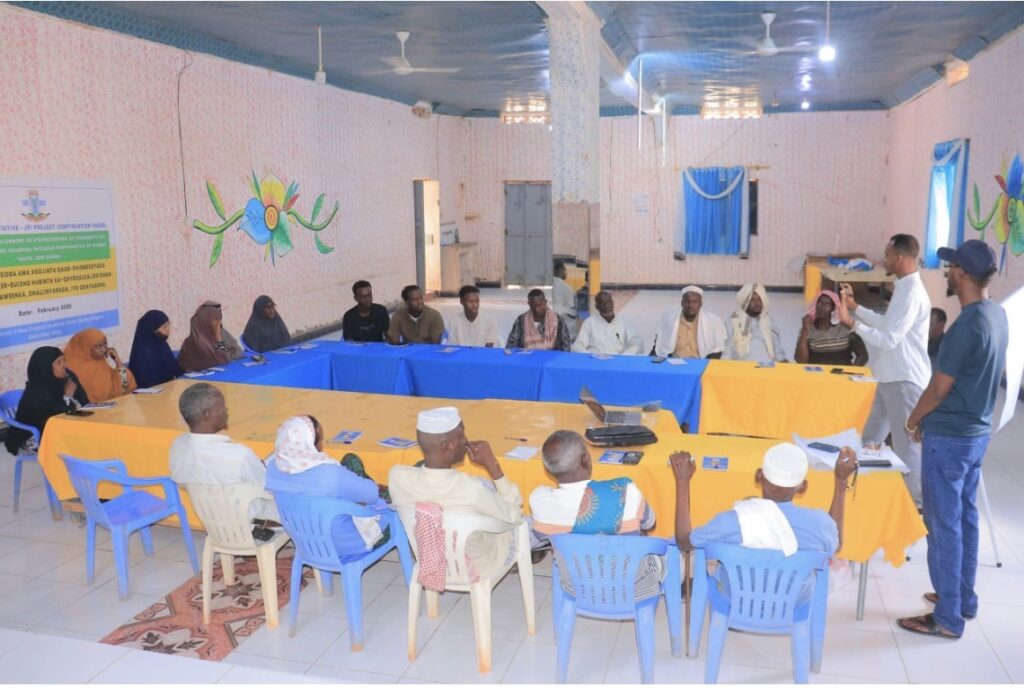
Farhiya, among other participants during the 15-member committee participating in a workshop at Bandiradley settlement